Peter Cameron Scores with a Coming of Age Novel for Teens

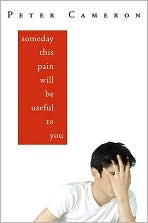
Someday this pain will be useful to youPeter Cameron is not an overly prolific author, but I do savor each of his works when they are published. His latest novel, Someday this pain will be useful to you, is an elegant coming-of-age tale about 18-year-old James. Living in Manhattan, disdainful of people his age, enamored of the idea of buying a big house in the midwest, James Sveck has a wry, if immature sense of humor and an annoying propensity to focus on correct grammar when engaged in conversation.

James parents aren’t completely equipped to help James navigate this tricky transition from high school to college. His mother has just returned from Vegas after her third marriage… without her husband. His father is concerned that when James orders something pasta instead of steak in the executive cafeteria he comes across as faggy. When James runs away from a school trip to DC, he ends up seeing a psychiatrist, who he challenges at every turn, but in a refreshing turn, is unable to outwit. James has also got a crush on the man who works with him at his mother’s gallery, but when a case of poor judgment alienates him, he is left with only his aging grandmother, who he adores, to turn to for solace.

Cameron has created a unique, teen voice in Someday this pain will be useful to you, one that rings true, and is able to balance the many portraits of suburban and rural voices of youth in literature. His prose is economical and graceful, and his resolution satisfying without answering all of life’s questions.
Austin Grossman Does Superheroes Right

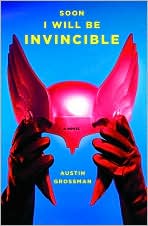
Soon I Will Be InvincibleWith the success of such movies as SPIDER-MAN, BATMAN, and THE X-MEN, and television shows such as “Heroes” and “So You Want To Be a Superhero,” it’s no surprise that an influx of novels about superheroes has appeared, much to this comic book geek’s delight. The first of the genre that I have embraced is Austin Grossman’s Soon I Will Be Invincible. Grossman is clearly familiar with the superhero world in comics, and he uses that world as the setting for his novel. There are two points-of-view in Invincible, bouncing back and forth between the villainous Dr. Impossible, and the newest member of the crime-stopping Champions, Fatale.

Grossman does a great job getting into Dr. Impossible’s head. After coming so close to conquering the world so many times, sent to prison, escaping, and repeating the cycle again and again, it’s interesting to see what motivates this super-genius to keep going. It seems that super-villainy is just hard-wired into his head. He’s got one more idea up his sleeve, and when the opportunity presents itself, he does the expected: busts our of prison, rebuilds his weapons and tries to take over the world.

Having disbanded a few years ago, the Champions come together again due to the mysterious disappearance of the best and brightest of their members, CoreFire. He was the most powerful of them all, unbeatable and charismatic, so when he seems to be missing for real, the Champions, Blackwolf – the Ultimate Crimefighter; Damsel – First Lady of Power; Elphin – Warrior Princess; Feral – Savage Street Fighter; Mister Mystic – Man of Mystery; and Rainbow Triumph – Teen Idol with an Attitude, feel duty bound to reunite and solve the mystery. To their ranks, they add a couple of newcomers; Lily, a mysterious, superpowered outcast from the future, and Fatale – the Next Generation of Warfare. It’s understandable that Grossman choses Fatale to be the readers’ entry into the superhero world. She’s new to the game, having received her powers after a freak accident destroyed most of her body and being transformed by new technology into a cyborg agent. Fatale is thrust into the glamorous world of the superhero elite all the while feeling she must constantly prove herself just to stand among them.

While the book is an entertaining read, and I do recommend it, I think the problem with using Fatale as one of our narrators is that when the finale arrives, and she is not a part of it, the reader is left on the outside looking in, when it would have been nice to have our point of view in the midst of the action. It’s like being sidelined for the big finish, and it’s a little distracting. Still, Grossman’s world is certainly representative of our own if it were populated by men and women with extraordinary powers.

Gaiman Spins a Dark Fantasy for Kids

CoralineMy reading theme for vacation last week was catching up with books being adapted into films. Neil Gaiman’s dark fantasy for youth is called Coraline, and it tells the tale of a girl who stumbles upon a terrifying nightmare world right next to her own in the last couple of weeks of summer vacation. Think back to your childhood; think back on your summer vacation. For many, the last couple of weeks in August herald a transition time. The summer is starting to get a little boring, and while your mind was once occupied with exploring, playing, dreaming, now thoughts turn excitedly toward school. Such is the case with Coraline. Her parents don’t have time to keep her entertained, and while the eccentric tenants who live in the other parts of her building provide curious diversions, they aren’t quite enough. One day Coraline discovers that the door in the study which usually opens to a blank brick wall now opens to a long, dark tunnel. What else is there to do in the dog days of summer but explore the tunnel?
What Coraline finds is a strange world where her other-mother and other-father live. The eccentric tenants are represented as well, as is the aloof, black cat that lives out in the yard. The people are interesting, but a little off-kilter, and instead of eyes, black buttons stare unblinkingly form their faces. For the better part of a day, Coraline enjoys exploring this new, strange world, but when it comes time to leave, Gaiman’s fable takes a decidedly dark turn. In the days leading up to school, Coraline must fight for her soul, the souls of the children who have come before her and the lives and souls of her parents.

Gaiman spins a tale reminiscent of the fairy tales of youth. There is something safe and comforting about them even as the plucky heroine faces chilling and very-real danger. Here’s hoping Coraline makes for a good film-adaptation, and since it is animated, the visuals will surely have a huge impact on its success. The film is currently in post-production and is scheduled for release next year. It will feature the voice of Dakota Fanning as Coraline, Teri Hatcher as her mother (and her other-mother), and the brilliant Dawn French and Jennifer Saunders as two of the neighbors. This is a quick read, and I highly recommend it.

Preparing for the Film Release

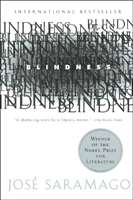
BlindessJosé Saragamo’s Blindness was the winner of the 1998 Nobel Prize for Literature. As the inhabitants of an unnamed city go blind one by one, the very fabric of society begins to decay until it is transformed into an animalistic morass of survival. That is the premise of Saramago’s intensely powerful and challenging novel. The core of the story revolves around seven people, among the first to go blind, along with a doctor’s wife who for some reason never loses her sight, but keeps this fact hidden from all save her husband.

Saramago explores how the removal of sight causes the destruction of the social structure. Even before the entire community goes blind, the government, fearing (rightly) an epidemic, quarantine all the blind under inhumane conditions. Yet as the worst of human society emerges, so too does compassion and cooperation, as we follow the seven main characters and watch as they form their own family to insure their survival.

Blindness is not a beach-reading novel that you can flip through in a day. It require concentration and reflection. Saramago pulls the reader into some pretty horrific situations as some of the downtrodden take advantage of others. With the character of the doctor’s wife, the sole sighted person in a city filled with the blind, Saramago creates a character both helpless and with great responsibility to those around her. It’s an insightful allegory to our world today.

I decided to read Blindness after finding out that it has been adapted for the screen by writer/director/actor extraordinnaire, and my pal, Don McKellar. It’s sure to be a harrowing experience.

Engrossing Fantasy of the Highest Caliber

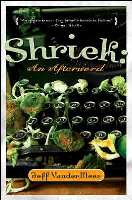
Shriek: an afterwordWhenever I am going to meet an author I try to read some of their work beforehand. At ALA this year I attended a dinner with Jeff VanderMeer, and on the plane to DC I started reading his latest fantasy novel Shriek: An Afterword. I only made it through the first 100 pages of so before meeting him, but I could tell there was quite a bit of talent in the man.

Shriek: An Afterword is of that fantasy genre that I don’t often read: alternative histories that may or may not be earth. It is also a biography of sorts of the Shriek siblings, Duncan written by his older sisterS Janice. Likewise it is a “biography” of their strange city, Ambergris. In Shriek, Janice is looking back on her life and writing an afterword for one of her historian/writer brother’s books. The Shriek’s lives were marked by the sudden death of their father after receiving the announcement that he had won a prestigious literary award, when they were children. Is this event the one that started Duncan down the path of an obsessive historian with radical theories perhaps too outlandish for others to fathom? And is this why Janice longs for recognition even while self-destructively indulging in every pleasure imaginable? The Shrieks eventually become fixtures in Ambergris’ culture, both reaching populist heights and tragic lows.

The river-city of Ambergris itself is perhaps the most potent character in the novel. Think of a grand, decaying New Orleans, complete with an underground city of quasi mushroom dwellers known as Gray Caps and you might get a sense of what Ambergris holds. Duncan’s obsession focuses on the Gray Caps and his first work, Cinsorium: Dispelling the Myths of the Gray Caps becomes a best-seller. During his research, Duncan uncovered hints of dark secrets connecting the Gray Caps to an horrific event that nearly destroyed the city years back. He also picked up a bizarre fungal condition that remained with him for the rest of his life. Janice unspools the pair’s story with tantalizing hints of their fate, augmented by notes from her brother, sometimes reinforcing, sometimes contradicting what she writes. It is a fascinating and compelling addition to the city’s lore.

VanderMeer has created a masterfully detailed, complex, fantastical novel, so utterly and darkly creative. The voices of Janice and Duncan are unique and true, revealing their all-too human flaws even while endearing them to the reader. Shriek: an afterword calls to mind Mary Gentle’s glorious White Crow novels, Rats & Gargoyles and Architecture of Desire in its gloriously giddy sense of the historical and the fantastic. This was one absorbing and entertaining read.