Now we are firmly in the Top 10. There have been a lot of films I have enjoyed in the past few years that center on indigenous people around the world, so I thought I’d trey reading some books by Native American, and other indigenous authors from various parts of the world. The first of which appears in my Top 10. Also the first of the several memoirs by female musical artists to hit the Top 10 makes their appearance.
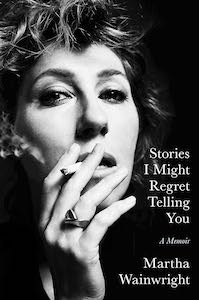
#8 – Stories I Might Regret Telling You: A Memoir by Martha Wainwright (2022)
Another enjoyable celebrity bio in the rock & roll vein. Martha Wainwright has a fascinating career and life in her own right, but as she mentions more than a few times in this book, she also comes from music royalty, with her mom, Kate McGarrigle, her dad, Loudon Wainwright III, and her older brother, Rufus Wainwright. Martha was always struggling to keep up creatively with her famous parents and brother, and arguably succeeded, even though she often felt inadequate. She also led a sometimes wild, rock & roll, partying lifestyle that makes for entertaining reading. She’s definitely a heart on her sleeve kind of woman, and doesn’t hold back. It was a quick, fun read, that doesn’t shy away from some of the darker and sadder part of life as well. Sometimes it reminded me of Sarah Polley’s recent book of essays, Run Toward the Danger, in the quirky, matter of fact way she told some disturbing stories. It certainly made me want to go back and listen to more of her music!
#9 – Swim Home to the Vanished by Brendan Shay Basham
Brendan Shay Basham has constructed a novel exploring grief with such poetry, and such visceral imagery, that it’s hard to shake. Damien is struggling with the loss of his younger brother Kai, who was swept away by a river and drowned. Damien’s odyssey takes him from the Pacific Northwest, through the dessert, to an isolated fishing town under the iron-rule of a family of brujas (witches.) As his journey progresses, he is slowly being transformed into a fish.
Everyone in this novel is grieving, especially the earth, and nature itself. For many, grief leads to a violent lashing out, and woe to those in that path. With exquisite language and a hard-hitting, dreamlike narrative, Swim Home to the Vanished is quite a feat for this first time novelist.
As we close in on the Top 10, the next two titles, also works of fiction, are books that I have been meaning to read for a while, and finally got around to last year. One is a science fiction novel by an author whose work I tend to enjoy but I’ve only read a handful of, and the other was the breakthrough novel of a Massachusetts author that I am finally going back to.
#11 – Night Sky Mine by Melissa Scott (1996)
Melissa Scott creates a complex world where humanity is divided into Company, Union, and Traveller, and computer programs are anthropomorphized as animal and plantforms. The Internet has grown to include something called the Wild Net were there programs run wild and free, possibly even threatening to grow into something so monstrous as to destroy all other programs in the system. In this universe a small group of disparate characters find themselves thrown together to solve a mystery that blossoms into something bigger than they imagine. Scott’s imagination and commitment to racial and sexual diversity was ahead of its time in 90’s science fiction, and her imagination was taking early technological advances in software and web work to unimaginable heights.
#10 – The Emperor’s Children by Claire Messud (2006)
I’m not someone who is in the habit of reading big best-sellers, so I’m coming to this novel late, a few years after reading and enjoying Claire Messud’s subsequent novel, The Woman Upstairs. The talented writer weaves together the lives of three college friends who have all gone on to the big city of New York to make their marks on the world. Danielle hails from Ohio, and lives in a small Village studio apartment while struggling as a documentary film producer. Marina lives a highly privileged life, biding time while she writes her book about children’s clothing. She is part of the wealthy and esteemed Thwaite family, the patriarch of which is either an insightful arbiter of culture, or a blowhard with little left to say, depending on who you ask. Finally, their friend Julius, once a well-known, and pointed arts critic, who is now finding he needs something more in his life than the bed-hopping, partying lifestyle for which he is known. One additional key character, Frederick, or Bootie, as his mother calls him, is Marina Thwaite’s cousin from the midwest, who in brilliant, socially clueless. After dropping out of college because of his perceived indignation around the educational system, he finds himself living with his wealthy relatives in New York while he plans his future.
The Emperor’s Children is a tough book, not because it difficult to read; on the contrary, Messud is a talented writer, and I rolled along with no trouble, but because none of the characters are particularly likable (the exception being the nearly saintly Annabel Thwaite – matriarch of that family). What make Messud’s novel so successful is it’s beautiful capturing of a time period, one that undergoes a massive change that many of us over a certain age also endured. It’s strange, how twenty years a later a very different, but even more far-reaching upheaval would make this book so relevant again.
We started with two rock ‘n roll memoirs, and we move to two novels. Two novels that are very different from each other, actually. One by an author whose complete works have been read by me; the other, someone I read for the very first time. Let’s take a look…
#13 – You Only Call When You’re in Trouble, by Stephen McCauley (2024)
Stephen McCauley writes engaging novels revolving around quirky, but all-too human characters, often in unconventional families. While his latest and eighth novel, You Only Call When You’re in Trouble, and his first since 2018 is well-written and entertaining, it does feel a bit like well-trodden ground. There’s something very familiar about the structure, and the dilemmas facing the characters. For some readers, this may feel comforting, like a favorite, well-worn bathrobe on a chilly winter night, and while there was some element of that for me, I also was looking for something a little more fresh, and reading this felt a little fomulaic. Still, I did tear up a bit in places, and chuckled while reading, so definitely a worthy addition to his bibliography.
The Memory of Animals, by Claire Fuller (2023)
An engrossing read that packs three distinct storylines into one novel fairly successfully. Fuller starts with virulent pandemic sweeping the world, that is a bit more apocalyptic than what we all recently endured, but is similar enough to bring back some pretty tense memories. Neffy is a marine biologist who volunteers for a dangerous study where she will be injected with the virus and a possible vaccine along with a handful of other test subjects. Just as she undergoes the first phase of the trial, the world goes to hell and when she recovers she finds herself trapped in the hospital with four other subjects.
As they try to adapt to their new lives, Neffy discovers that Leon has an experimental device that allows her to relive her memories, an experience that can be dangerously addictive, but through these experiences we learn about Neffy’s life, and what led her to Fuller’s third storyline, about Neffy’s relationship with the mysterious H, to whom she is writing letters to in her journal. It doesn’t really add up into a coherent whole, but all the stories are compelling, and Fuller’s exploration of memory (the pandemic attacks memories, while Leon’s device allows you to relive them) is interesting.
Well, it’s been a while. In fact, I haven’t posted here since I did my round up of favorite movie of 2022! I guess it has been a busy year. That is evidenced by the fact that I only read 24 new books last year. However I did get stuck on a new genre. I have become temporarily addicted to the rock ‘n roll memoir of female artists. Last year I read eight books in this genre (and one more by a male artist), covering such artists as Carly Simon, Tracey Thorn, Holly Knight, and Liz Phair. You will see many of these books included in my lists of favorites of the year (I mean, with this genre making up 33% or my reading last year, they’re going to have to show up, right?)
I’m not going to try to do better this year, as it’s February already and I’m only halfway through my second title (both of which have been in that afore-mentioned genre) but I’ll do my best. In the mean time, here are my numbers 15 and 14 favorite books I read in 2023.
#15 – Boys in the Trees: a Memoir, by Carly Simon (2015)
Carly Simon’s life is certainly one filled with fodder for a good memoir. And those familiar with the lyrics to her huge song catalog can probably read between the lines to understand the full, emotional life she has led. From her uniquely interesting childhood, through her difficult coming-of-age and emergence into a incredibly popular performing artist and a celebrity marriage, there’s a lot to focus on. The book is largely divided into two sections, her childhood and coming-of-age, which was focused on family and her emerging sexuality, and her marriage to James Taylor. Family and relationships are certainly the focus of Simon’s writing, with her career as a singer/songwriter an important backdrop.
Simon is a good writer, capturing moments to devastating or glorious effect. She focuses in on small examples of a larger life and peels back layers to expose the flawed humans beneath. Personally I am somewhat perplexed in many of these memoirs I have recently read how major the theme of being with a man was so important to build a fulfilling life. While her fascinating career is ever-present, it seems to be almost a background element to the story she wanted to tell. I would have liked a bit more of that career.
#14 – Chapter and Verse: New Order, Joy Division and Me, by Bernard Sumner (2015)
Here’s my one rock ‘n roll memoir by a male artist. Bernard Sumner tells the story of his life from his childhood in the town of Salford, near Manchester England, through his time with Joy Division and then New Order. I particularly enjoyed the passages about his love of music and creating the sound for New Order… less so the extensive chronicling of their hedonistic lifestyle. He does respond to the horrible things said about him by former bandmate Peter Hook, but more in a reporting way, rather than an attack back.
Sumner has a conversational writing style that makes for easy reading, but he tends to repeat himself, which can get a little tiresome now and then. Overall, a fun read, and illuminating for a casual fan of the music who didn’t know much about his life.
And here we are at the top of my list of favorite films of 2022. What ties these films together are the broad themes of love and family… themes that go against my often-cited love of bleak films. These two films moved me, but also thrilled me with the acting, the scripts, the directions, the production design, the use of music, the cinematography and more. These were films that stuck with me long after I saw them. I first saw my #1 film of the year way back in January, and it never got knocked off the top spot. I do hope you will give these films a try!
After Yang
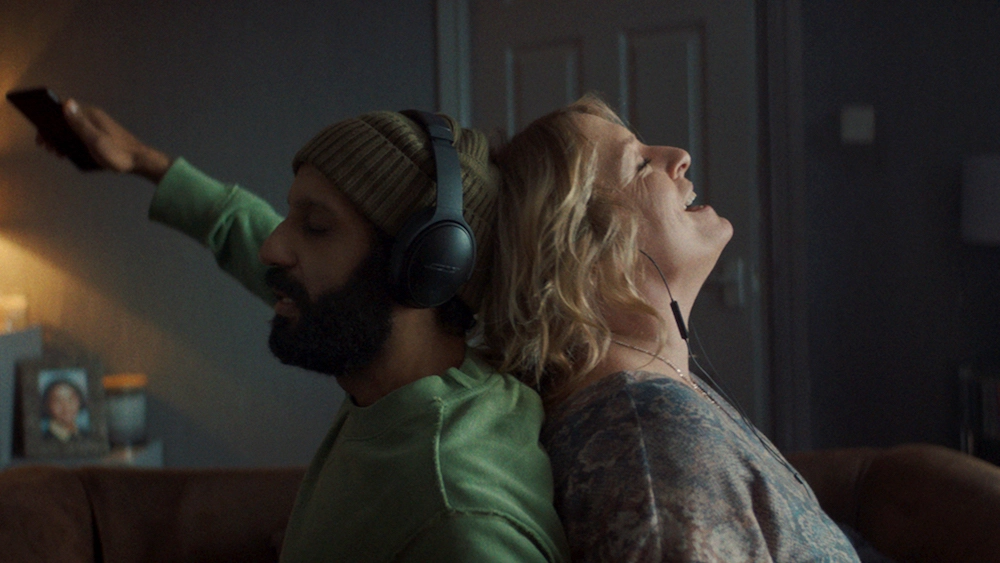
#2) Ali & Ava, directed by Clio Barnard – Clio Barnard, innovative director of the Buried Treasure nominated pseudo-doc THE ARBOR, has created a nearly perfect adult romance with ALI & AVA. the third of her four films to be shot in the city of Bradford in England. Led by a pair of terrific acting performances from Adeel Akhtar (THE BIG SICK, FOUR LIONS) and Claire Rushbrook (SECRETS & LIES; AMMONITE) the film charts the tentative love story of two Bradford natives in their forties both emerging from challenging relationships. Ali is a landlord who lives with his Pakistani family and is a bit of an anomaly, as he is beloved by his tenants. He and his younger wife are recently estranged, but still live in the same flat with the rest of the family, whom they have not told about their separation. Ava works as a teaching assistant, comes from an Irish-Catholic background, has a complicated relationship with her adult children, and an even more complicated relationship with her deceased husband. Once the two meet their slow, quiet attraction develops into something more, all while Barnard subtly weaves in issues around race, religion, abuse, and other grown-up issues in ways that are natural and powerful.
One of the things that makes ALI & AVA so unique is how the story is told so strongly through music. Ali is a fan of techno and hip hop, while Ava adores country and folk. They fall in love and get to know each other through small acts of generosity and kindness, but also through their mutual love of music and the curiosity for each to learn more about the other. The film is hopeful, although not predictable or formulaic in any way. The cinematography by Ole Bratt Birkeland is stunning, both in the way it captures surprising beauty in some of the neighborhoods that exhibit the worst levels of social deprivation, and the extraordinary ways it captures the love story being told with powerful close-ups of the two leads. This one’s a real winner in so many categories, and Clio Barnard is a director to keep an eye on.
After Yang
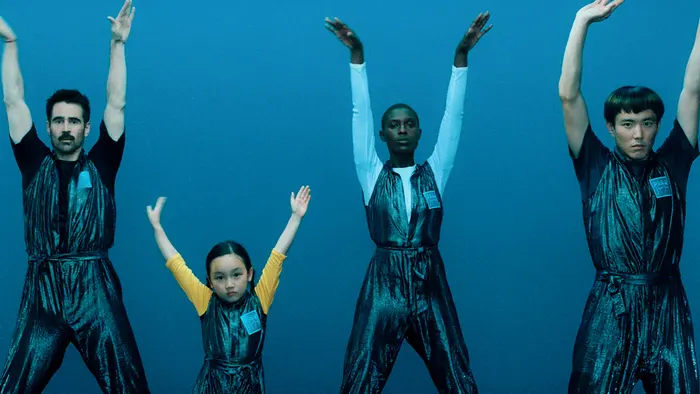
#1) – After Yang, directed by Kogonada – After the gorgeous simplicity of Kogonada’s Chlotrudis Awards-nominated previous film, COLUMBUS, I’m not sure what I was expecting with this follow-up, starring a big name star like Colin Farrell. Of course, Farrell was so powerful in THE LOBSTER, so I know he’s capable of being a great actor as well, which he shows again, in this haunting adaptation of a short story that explore what it means to be alive and sentient. It’s a story we’ve seen explored before; several times in the last couple of years. Yang is an artificial person — an older brother for Jake and Kyra’s adopted Japanese daughter Mika. Someone marketed to give Mika cultural reference given her parents are white and African respectively. When Yang malfunctions, possibly permanently, Jake begins an exploration that will reveal parts of Yang’s life that illuminate heretofore unknown depths.
The futuristic world Kogonada creates is uniquely serene and beautiful. The lovely production design that suggests a future society, yet is familiar and comfortable, with its sleek and graceful beauty augments the immersive experience of the film. As mentioned above, Farrell, who broke on the scene as a brash, bad-boy once again shows how skilled he is at nuanced, mature roles. Kogonada’s direction, so minimalist in COLUMBUS, is more expansive here, but just as simple and effective. Finally, AFTER YANG features one of the best ever opening scenes of any film that touches on one of my favorite film tropes: unexpected dancing. A true triumph.
And here’s the complete list for my Top 30 films of 2022:
 Another enjoyable celebrity bio in the rock & roll vein. Martha Wainwright has a fascinating career and life in her own right, but as she mentions more than a few times in this book, she also comes from music royalty, with her mom, Kate McGarrigle, her dad, Loudon Wainwright III, and her older brother, Rufus Wainwright. Martha was always struggling to keep up creatively with her famous parents and brother, and arguably succeeded, even though she often felt inadequate. She also led a sometimes wild, rock & roll, partying lifestyle that makes for entertaining reading. She’s definitely a heart on her sleeve kind of woman, and doesn’t hold back. It was a quick, fun read, that doesn’t shy away from some of the darker and sadder part of life as well. Sometimes it reminded me of Sarah Polley’s recent book of essays, Run Toward the Danger, in the quirky, matter of fact way she told some disturbing stories. It certainly made me want to go back and listen to more of her music!
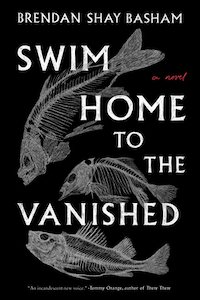 Brendan Shay Basham has constructed a novel exploring grief with such poetry, and such visceral imagery, that it’s hard to shake. Damien is struggling with the loss of his younger brother Kai, who was swept away by a river and drowned. Damien’s odyssey takes him from the Pacific Northwest, through the dessert, to an isolated fishing town under the iron-rule of a family of brujas (witches.) As his journey progresses, he is slowly being transformed into a fish.
 Melissa Scott creates a complex world where humanity is divided into Company, Union, and Traveller, and computer programs are anthropomorphized as animal and plantforms. The Internet has grown to include something called the Wild Net were there programs run wild and free, possibly even threatening to grow into something so monstrous as to destroy all other programs in the system. In this universe a small group of disparate characters find themselves thrown together to solve a mystery that blossoms into something bigger than they imagine. Scott’s imagination and commitment to racial and sexual diversity was ahead of its time in 90’s science fiction, and her imagination was taking early technological advances in software and web work to unimaginable heights.
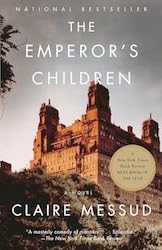 I’m not someone who is in the habit of reading big best-sellers, so I’m coming to this novel late, a few years after reading and enjoying Claire Messud’s subsequent novel, The Woman Upstairs. The talented writer weaves together the lives of three college friends who have all gone on to the big city of New York to make their marks on the world. Danielle hails from Ohio, and lives in a small Village studio apartment while struggling as a documentary film producer. Marina lives a highly privileged life, biding time while she writes her book about children’s clothing. She is part of the wealthy and esteemed Thwaite family, the patriarch of which is either an insightful arbiter of culture, or a blowhard with little left to say, depending on who you ask. Finally, their friend Julius, once a well-known, and pointed arts critic, who is now finding he needs something more in his life than the bed-hopping, partying lifestyle for which he is known. One additional key character, Frederick, or Bootie, as his mother calls him, is Marina Thwaite’s cousin from the midwest, who in brilliant, socially clueless. After dropping out of college because of his perceived indignation around the educational system, he finds himself living with his wealthy relatives in New York while he plans his future.
 Stephen McCauley writes engaging novels revolving around quirky, but all-too human characters, often in unconventional families. While his latest and eighth novel, You Only Call When You’re in Trouble, and his first since 2018 is well-written and entertaining, it does feel a bit like well-trodden ground. There’s something very familiar about the structure, and the dilemmas facing the characters. For some readers, this may feel comforting, like a favorite, well-worn bathrobe on a chilly winter night, and while there was some element of that for me, I also was looking for something a little more fresh, and reading this felt a little fomulaic. Still, I did tear up a bit in places, and chuckled while reading, so definitely a worthy addition to his bibliography.
 An engrossing read that packs three distinct storylines into one novel fairly successfully. Fuller starts with virulent pandemic sweeping the world, that is a bit more apocalyptic than what we all recently endured, but is similar enough to bring back some pretty tense memories. Neffy is a marine biologist who volunteers for a dangerous study where she will be injected with the virus and a possible vaccine along with a handful of other test subjects. Just as she undergoes the first phase of the trial, the world goes to hell and when she recovers she finds herself trapped in the hospital with four other subjects.
 #15 – Boys in the Trees: a Memoir, by Carly Simon (2015)
 #14 – Chapter and Verse: New Order, Joy Division and Me, by Bernard Sumner (2015)